The Witches
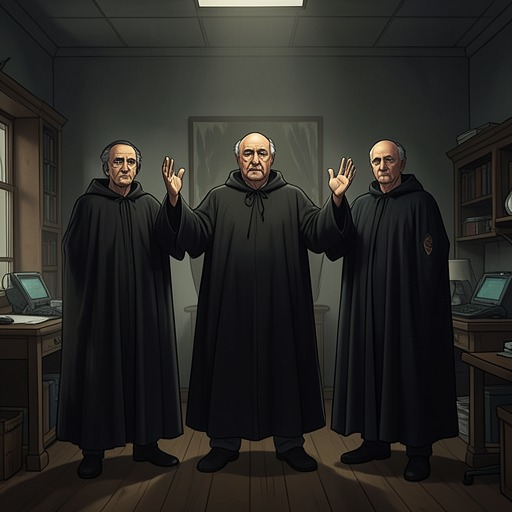
The KillerThe Witches are a two-person supernatural organization whose prophecies and disguises help redirect the play’s struggle for power. They predict a royal future for Macbett and a dynasty for Banco, then use a concealed transformation to entangle Macbett in a marriage that is not what it seems. Their influence is both political and theatrical: they do not simply foretell events, but shape what powerful men believe about succession, loyalty, and their own control of destiny.
Prophecy and Political Consequences
The Witches’ predictions become a force in Banco’s understanding of the new regime. Alone onstage, he reviews how their forecasts have come true, including Macbett’s ascent to kingship after the careers of Candor and Glamiss. He also recalls their prediction that he would father a succession of kings, princes, presidents, and dictators. The promised future is not an uncomplicated reward: Banco has no children and is not married, yet the prospect of a dynasty gives him some consolation even as he envies Macbett’s wealth, fame, power, and wife.
Banco’s account shows prophecy changing desire rather than merely confirming it. Before meeting the Witches, he says, he had no ambition beyond serving his king. Their forecast awakens envy and jealousy, making him imagine a family line and a future political importance he did not previously seek. He plans to marry the Lady in Waiting, start a family, become chamberlain, and eventually curtail Macbett’s power from behind the throne. The prophecy thus helps turn a former servant of the crown into a rival with designs of his own.
Macbett overhears Banco’s private reflections and treats the prediction of Banco’s descendants as a threat. He wonders whether he killed Duncan only to place Banco’s heirs on the throne, and concludes that he can frustrate what he regards as the Witches’ design by killing Banco himself. He calls Banco to him and stabs him in the heart. The prophecy therefore helps produce the violence meant to prevent its fulfillment: Macbett’s effort to cut off Banco’s line begins with Banco’s murder, while the play later discloses that Banco is indeed Macol’s father.
Disguise, Ritual, and the False Queen
The Witches’ influence also takes material form in the supposed Lady Macbett. After the ceremony, the woman removes the sacred crown and the cross necklace, which she says has been burning her, and declares that curses have doused the wound on her chest. She describes the cross as the point where the forces of heaven and hell contend, while also rejecting the white dress and the religious objects she had endured during the ceremony. These actions expose the gap between the solemn public image of a crowned queen and the supernatural identity concealed beneath it.
The Lady in Waiting assists with the change by opening a case and dressing the woman in a witch’s costume. The stage directions make the transformation deliberately grotesque and visible: the disguise includes an old dress, a vomit-covered apron, dirty gray hair, removed teeth, and a pointed nose. What had appeared to be a royal marriage is thus revealed as an act of concealment, performed through costume and ceremony rather than through any stable transformation of identity. Macbett later recognizes the woman as an old hag whose appearance, movements, and voice had been made more beautiful.
The two Witches hurry to finish the operation, close the case, and congratulate one another on a job well done. They say that Macbett will not be able to escape the result, that their boss will be pleased, and that another mission awaits. Their exchange presents their work as organized service: they complete a task together, report upward to an unnamed superior, and prepare to leave for a further assignment. The text does not identify that superior, but the Witches’ reference to another mission makes clear that their intervention belongs to a continuing operation beyond the immediate court.
Organization and Methods
The Witches act as a pair, with the First Witch and Second Witch exchanging instructions and coordinating the disguise. Their urgency is practical as well as theatrical: one presses the other to hurry because others are waiting. Once the task is complete, they sit astride their case and use it as a flying vehicle. The First Witch mimes steering while the Second spreads her arms like wings; a blackout and spotlight leave the audience with the image of the case in flight. This exit makes their mobility part of their power: they can intervene in the palace and then vanish beyond the reach of ordinary pursuit.
Their methods combine foreknowledge, bodily transformation, costume, and escape. A witch transforms the woman who bears Banco’s child into a human being from a gazelle, then the mother changes back into a gazelle after the birth. That account, given by Lady Duncan, links the Witches’ supernatural activity to the hidden parentage of Macol. The text does not specify which of the two Witches performed this transformation, so the episode establishes a capacity associated with witchcraft without assigning the act to either named member.
Exposure and Narrative Significance
When Lady Duncan returns, Macbett’s search for the vanished false queen becomes an attempt to recover control. He orders searches of forests and countryside, sends people to houses, attics, dungeons, and cellars, and demands police dogs, border closures, patrol boats, searchlights, and reports every quarter of an hour. He even threatens war against neighboring states that refuse extradition and orders the arrest of old women who look like witches. The breadth of the response contrasts with the Witches’ effortless departure in their flying case: Macbett mobilizes the machinery of a state against an enemy he cannot locate.
The exposure of the deception also makes the prophecy of Banco’s line newly consequential. Lady Duncan reveals that Macol is not her biological son: Duncan adopted him, while Banco fathered him with a woman who had been transformed from a gazelle. Macol claims the right to resume his father’s name and establish a dynasty, while Lady Duncan insists that Duncan cared for him and sent him to Carthage University. The revelation does not simply confirm Banco’s paternity; it unsettles the apparent royal family and gives the Witches’ predictions a dynastic dimension that Macbett’s violence has failed to erase.
The Witches’ dramatic power rests on the distance between prediction and control. Their forecasts prompt ambition, suspicion, and murder, while their disguise makes kingship itself appear vulnerable to performance. Macbett tries to defeat the future by attacking its supposed source, but Banco’s hidden lineage survives the killing, and the Witches disappear before the ruler can seize them. Their role is therefore not that of detached prophets: they are agents within the political action, able to manipulate appearances and set consequences in motion while leaving others to mistake force for mastery.